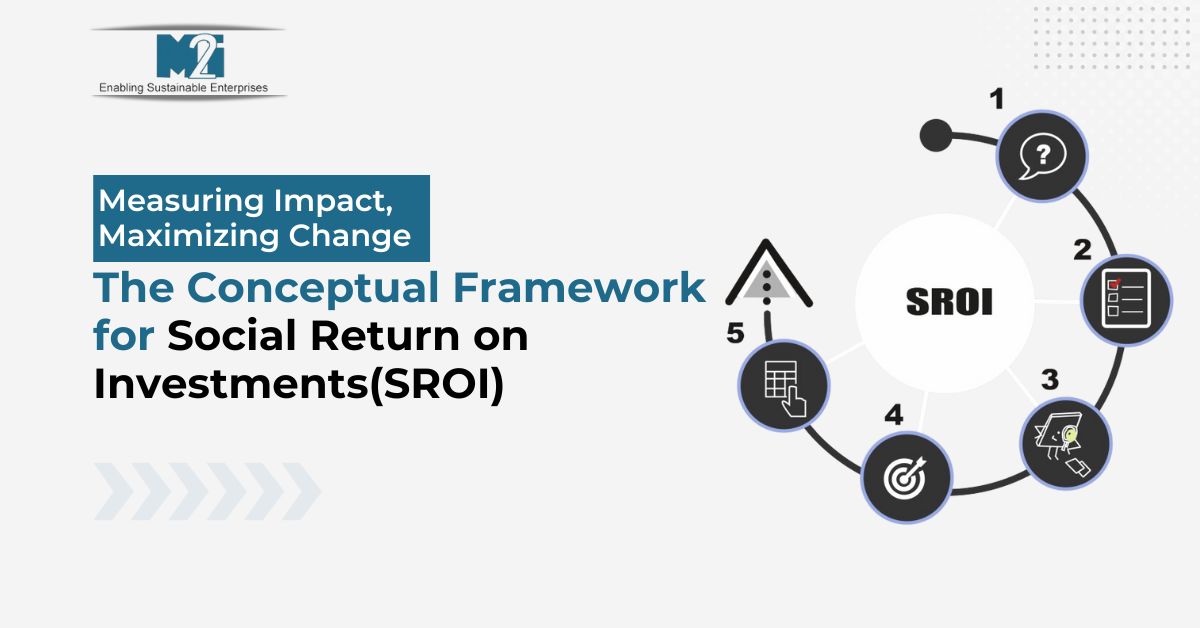
Measuring Impact, Maximizing Change: The Conceptual Framework for Social Return on Investments (SROI)

Introduction
Social Return on Investment (SROI) is a framework for measuring and accounting for social and environmental values created by the organisations. SROI measures changes which are relevant to the people or organisations that experience or contribute to it.
SROI estimation process
SROI is an elaborate process and involves close consultations with various stakeholders (including sample survey of beneficiaries) as well as analysis of project data and secondary data. SROI is calculated for each project separately. Following are the key steps involved in the SROI process, once the project for which the SROI has to be estimated has been finalised.
Tools and activities
-
Review of project theory of change
-
Semi-structured interviews with the stakeholders
Tools and activities
-
Review of secondary data
-
Semi-structured interviews with the stakeholders
Step 3: Estimating volume of the outcome: Volume of the outcome can be estimated by reviewing data from the MIS as well as through primary surveys of the project beneficiaries.
Tools and activities
-
Review of MIS data
-
Sample survey of beneficiaries
-
Discussions with stakeholders
Tools and activities
-
Review of MIS dataSample survey of beneficiaries
-
Sample survey of control group respondents
-
Discussions with stakeholders
Step 5: Estimating attribution: In case multiple stakeholders are involved in the project, the volume of the impact which can be attributed to the efforts of the other stakeholders will need to be calculated and excluded from the calculations.
Tools and activities
-
Discussions with stakeholders
-
Review of project activities and documentation
Step 6: Estimating investments: Investments made by the organization as well as other stakeholders will need to be estimated. This will include the cost of the time of volunteers engaged by the organisation, if any.
Step 7: Calculations for SROI: SROI estimation involves the following calculations
-
Projecting the value of outcomes into the future. Drop-offs will be accounted for while projecting.
-
Calculating the Net Present Value(NPV) using appropriate discount rates.
-
Calculating the SROI ratio by dividing the Net Present Value of outcomes by the value of inputs.
-
Sensitivity analysis to check how the SROI changes when assumptions relating to outcome values, deadweight, drop-off and attribution changes.
Outputs for an SROI exercise
Output for an SROI is a detailed document showing calculations, assumptions and the process followed. Disclosure of the assumptions is one of the most important best practices while estimating the SROI. Documentation of the SROI process, therefore, becomes critical.